


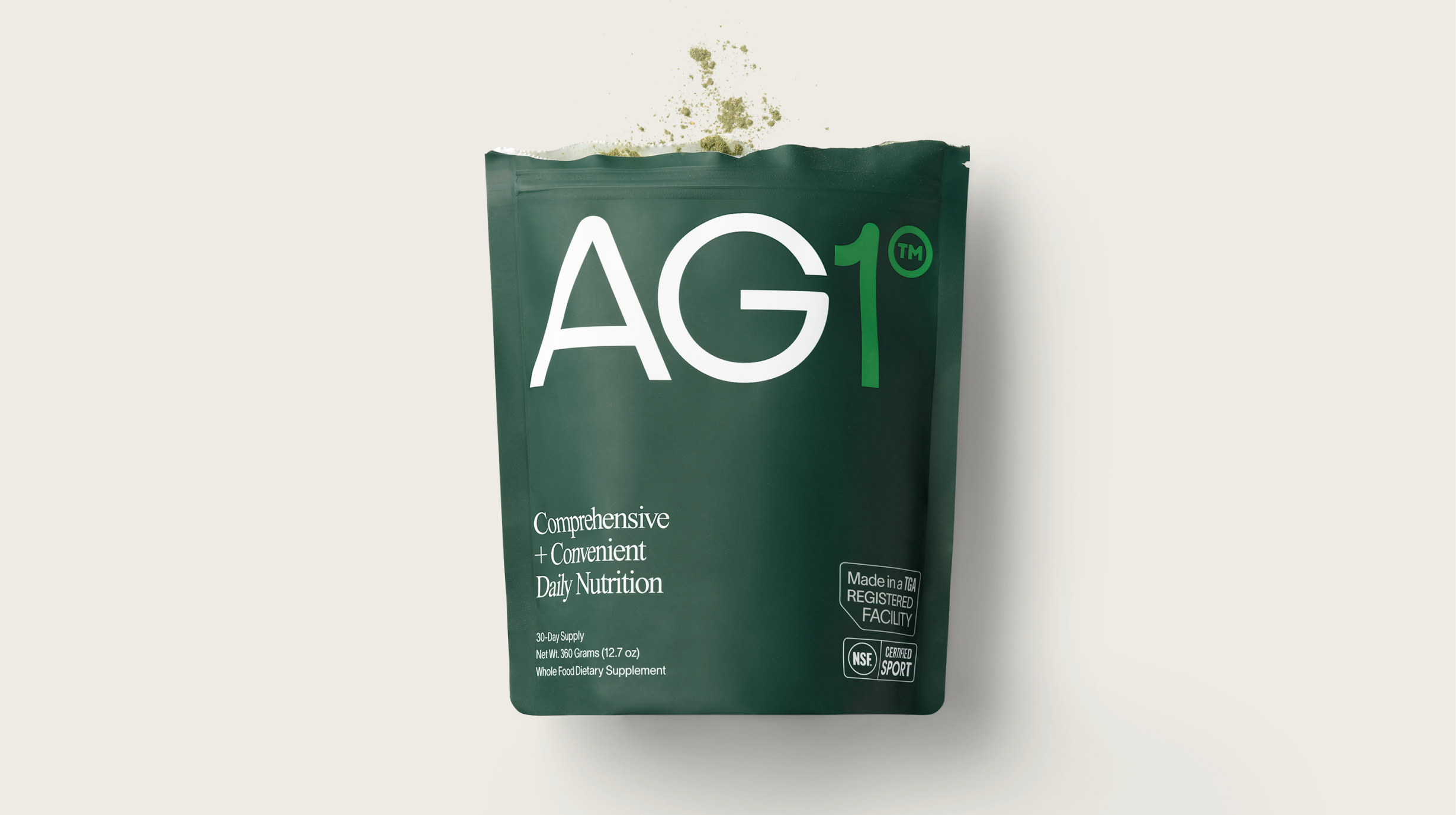
AG1 is one of the most heavily marketed supplements on the internet. It promises to support energy, immunity, digestion, and more — all in one daily scoop. But does it actually help with sleep?
This comparison isn't a takedown of AG1. It's a factual look at what AG1 contains, what it was designed to do, and where it falls short if sleep quality is your primary goal. Understanding the difference between a general wellness powder and a targeted sleep supplement helps you spend your money on what actually matches your needs.
What AG1 Actually Is (and Isn't)
AG1, formerly called Athletic Greens, is a daily greens powder positioned as a nutritional foundation — a way to fill gaps in a modern diet. It contains a broad range of vitamins, minerals, adaptogens, digestive enzymes, probiotics, and plant extracts spread across several proprietary blends.
AG1 was not designed as a sleep supplement. Its formula prioritizes breadth over depth: touching on dozens of health categories rather than delivering therapeutic doses for any single one. That design choice is a feature, not a flaw — but it matters when you're evaluating it against products built specifically to address sleep.
A significant portion of AG1's formula sits inside proprietary blends with disclosed totals but no per-ingredient amounts. You know the "Alkaline, Nutrient-Dense Raw Superfood Complex" weighs 7,388 mg total, but not how much of that is spirulina versus ashwagandha versus anything else. This makes it impossible to verify whether sleep-relevant ingredients are present at therapeutic doses.
This matters enormously for sleep. The research on magnesium, L-theanine, glycine, and ashwagandha is dose-specific. A study showing glycine improves sleep quality used 3,000 mg. Half that dose, or 50 mg hidden in a blend, is unlikely to produce the same effect. Knowing an ingredient is present and knowing it's present at a meaningful dose are two very different things.
Sleep-Relevant Ingredients: AG1 vs Dedicated Formulas
Let's look at the ingredient categories that matter most for sleep, and how each approach handles them.
Magnesium is the most important mineral for sleep. Its form and dose determine whether it's therapeutic or merely decorative on a label.
Form is not disclosed. At this dose level, supplementation may help fill a dietary gap but is unlikely to produce the nervous-system-calming effects shown in sleep research, which typically uses 200–400mg of a highly absorbable form.
Sub-therapeutic for sleepGlycinate is the highest-absorbing form, paired with glycine, which itself supports sleep. This dose range matches what sleep studies use. The form directly supports GABA production and nervous system downregulation.
Research-backed dose + formAdaptogens like ashwagandha reduce cortisol and stress response, which can indirectly support sleep — but only at the right doses and extract quality.
AG1 includes ashwagandha within its superfood complex, but the amount per serving is unknown. Research uses 300–600mg of KSM-66 or Sensoril extract daily for 8+ weeks. Without knowing the dose or extract type, the sleep benefit is speculative.
Dose unknown, likely lowProducts with a transparent label disclose the exact extract, standardization, and dose. KSM-66 at 300–600mg is the form and dose studied for cortisol reduction and improved sleep onset. You can verify what you're taking.
Specific extract + dose visibleAmino acids like L-theanine and glycine are among the most research-backed non-hormonal sleep ingredients. They work directly on neurotransmitter pathways involved in relaxation and sleep quality.
AG1's formula does not contain L-theanine or glycine — two of the most studied amino acids for sleep quality. These aren't typical components of a greens powder, which prioritizes vegetables, adaptogens, and vitamins over targeted sleep amino acids.
Not present in formulaL-theanine promotes alpha brain waves and calm without sedation. Glycine lowers core body temperature and improves sleep quality scores. At these research-backed doses, both are meaningfully present rather than decorative.
Full research-backed dosesThe Dose Problem: Why Amount Matters
The most common misunderstanding about supplement comparisons is treating ingredient presence as equivalent to ingredient efficacy. Whether something is listed on a label and whether it's listed at a dose that does anything are completely separate questions.
The chart below shows how far AG1's sleep-relevant nutrients fall from the doses used in clinical research — not to criticize AG1's overall formula, but to illustrate why it isn't functioning as a sleep supplement even when taken consistently.
AG1 does not disclose the form of magnesium in its formula. Magnesium oxide — the cheapest and most common form — absorbs at roughly 4%, meaning most of each dose passes through unabsorbed. Magnesium glycinate absorbs at 80%+. Even if AG1 contained more magnesium, an undisclosed form means you can't evaluate what fraction actually reaches your cells.
Head-to-Head Comparison Table
Scroll table to see all columns →
| Factor | AG1 | Dedicated Sleep Supplement |
|---|---|---|
| Primary Purpose | Daily nutritional foundation, general wellness | Targeted sleep quality and relaxation support |
| Magnesium Dose | ~80mg (form undisclosed) Sub-therapeutic | 300–400mg as glycinate Research-backed |
| L-Theanine | Not included | 200–400mg Research-backed |
| Glycine | Not included | 3,000mg Research-backed |
| Ashwagandha | Present but dose hidden in proprietary blend Unverifiable | KSM-66, 300–600mg, dose disclosed Transparent |
| Melatonin | Not included | Not included (in quality formulas) |
| Label Transparency | Partial — vitamins/minerals disclosed, blends not | Full — every ingredient and dose listed individually |
| Best Time to Take | Morning, with food | 30–60 min before bed |
| Cost per Serving | ~$3.30 (subscription) | ~$2.50 (varies by brand) |
| Verdict for Sleep | Unlikely to produce meaningful sleep improvement alone | Directly targets sleep pathways at studied doses |
"A supplement that does many things at sub-therapeutic doses is fundamentally different from one that does one thing at the right dose. Both have value — just not for the same purpose."
RestEase Editorial TeamWhen AG1 Might Indirectly Support Sleep
Being honest means acknowledging where AG1 can genuinely contribute to better rest — even if it wasn't designed for that purpose.
- Nutrient deficiency correction — If poor sleep is partly driven by widespread micronutrient deficiencies (B vitamins, zinc, vitamin D), a broad-spectrum supplement like AG1 may help by filling those gaps. This is an indirect effect, not a targeted sleep mechanism.
- Adaptogen stress reduction over time — Consistent daily use of the adaptogens in AG1 (ashwagandha, rhodiola) may gradually lower baseline cortisol over weeks or months, which can improve sleep quality as a downstream effect. This requires consistent use and weeks to evaluate.
- Digestive health connection — AG1's probiotics and digestive enzymes support gut health, and the gut-brain axis influences neurotransmitter production including GABA and serotonin precursors. Improved gut health may have modest sleep benefits over time.
- Morning routine anchoring — Taking AG1 at the same time every morning can help anchor your circadian rhythm through behavioral consistency, which supports better nighttime sleep as a side effect.
These are real but indirect effects. They're the kind of thing you'd notice over months of consistent use, not the kind of immediate sleep support you'd experience from a properly dosed magnesium glycinate and L-theanine formula taken 45 minutes before bed.

Recommendation: Dedicated sleep supplement first
- Start with a transparent-label sleep supplement with magnesium glycinate (300–400mg), L-theanine (200–400mg), and apigenin. These target sleep pathways directly at research-backed doses.
- Take it 30–60 minutes before bed as part of a consistent wind-down routine. Give it 2–3 weeks of nightly use to evaluate the full effect.
- AG1 can be a useful addition for overall health but will not address your sleep goals on its own. If budget allows both, they serve different purposes and can complement each other.
- Prioritize sleep hygiene habits alongside any supplement — schedule consistency and a dark, cool environment amplify supplement effectiveness.
Recommendation: AG1 may make sense for your goals
- For filling nutritional gaps, supporting energy, immunity, and gut health, AG1's broad-spectrum formula is well-suited. The wide ingredient range addresses many wellness areas at once.
- Don't expect meaningful sleep improvement from AG1 alone. If sleep becomes a concern, add a dedicated formula taken at night rather than adjusting your morning AG1 routine.
- Compare AG1's cost-per-serving against targeted supplements for your specific health goals — a high-quality probiotic, vitamin D, and B-complex individually may cover your needs at lower cost and with better dose transparency.
- The adaptogen component (ashwagandha, rhodiola) may gradually reduce baseline stress over 4–8 weeks of daily use, which has downstream benefits for multiple health markers including sleep.
Recommendation: Use both — but at different times of day
- Morning: AG1 with breakfast for daily nutritional foundation, broad adaptogen support, and gut health. This also reinforces a consistent morning anchor for your circadian rhythm.
- Evening (30–60 min before bed): Dedicated sleep supplement with magnesium glycinate, L-theanine, and apigenin. These work at night to support the specific physiological conditions that enable deep sleep.
- These products don't compete — they operate on different timelines and target different systems. AG1 focuses on daytime health; sleep supplements focus on nighttime recovery.
- If budget is a constraint, prioritize the sleep supplement. Sleep quality has downstream effects on almost every health marker AG1 targets — energy, immune function, cognitive performance — making it the higher-leverage investment.
Can You Use Both at the Same Time?
Yes — and for many people this is actually the ideal approach, because the two products are genuinely complementary rather than overlapping. AG1 is designed for mornings. Sleep supplements are designed for evenings. They don't share a use case.
A few practical points if you're taking both:
- No significant interaction concerns — The ingredients in AG1 and a typical sleep supplement don't compete or counteract each other. The adaptogens, probiotics, and vitamins in AG1 are metabolized during the day well before your evening sleep supplement.
- Watch total magnesium intake — If you're taking ~80mg from AG1 and 300–400mg from a sleep supplement, your total magnesium is in the 380–480mg range. This is within safe limits for most adults (the tolerable upper intake level from supplemental magnesium is 350mg for some guidelines, though many people tolerate higher doses well). Monitor for any digestive changes.
- Don't expect AG1 to replace sleep-specific ingredients — Taking AG1 as your "sleep supplement substitute" to save money means missing L-theanine, glycine, and proper magnesium dosing entirely.
AG1 is a well-formulated general wellness product with a strong following for good reason. It is not a sleep supplement. If sleep is your goal, a dedicated formula with fully disclosed ingredients at research-backed doses will outperform AG1 for that specific purpose — not because AG1 is bad, but because it wasn't designed for this.

- Every ingredient listed with its exact dose — no proprietary blends, no guesswork
- Magnesium glycinate, L-theanine, and apigenin at research-backed amounts
- Melatonin-free: supports natural sleep pathways without hormonal interference
- GMP-certified, third-party tested — designed specifically for sleep, not general wellness
Frequently Asked Questions
Does AG1 help with sleep?
Can I take AG1 and a sleep supplement at the same time?
Is AG1 worth the cost if sleep is my primary goal?
What makes a dedicated sleep supplement more effective for sleep than AG1?
How do I know if a sleep supplement label is trustworthy?
Sources
- Abbasi B, et al. (2012). The effect of magnesium supplementation on primary insomnia in elderly. Journal of Research in Medical Sciences. PubMed
- Bannai M, et al. (2012). New therapeutic strategy for amino acid medicine: glycine improves the quality of sleep. Journal of Pharmacological Sciences. PubMed
- Rao TP, et al. (2015). In Search of a Safe Natural Sleep Aid. Journal of the American College of Nutrition. PubMed
- Langade D, et al. (2019). Efficacy and safety of ashwagandha (Withania somnifera) root extract in insomnia and anxiety. Cureus. PubMed
- Walker M. (2017). Why We Sleep: Unlocking the Power of Sleep and Dreams. Scribner. Evidence base for sleep stage physiology and nutrient relationships.


